

I.What is Biocompatibility?
The biocompatibility of medical devices, in simple terms, refers to the ability of medical devices to "get along well" with the human body. According to the international standard ISO 10993-1:2018, it means the ability of a medical device or material to elicit an appropriate host response in a specific application.
Understanding this concept has three key points:
1. "Appropriate" response is crucial: Biocompatibility does not mean "no response", but rather requires that the human body's response is "appropriate" and acceptable. For example, a implant causing a mild, self-healing inflammatory response is a normal healing process, but if it causes a severe, persistent rejection reaction, it is biologically incompatible.
2. It is relative, not absolute: Whether a material is biocompatible is not its inherent property, but must be judged in the specific application scenario. The same material, when made into a suture that contacts soft tissue, is safe, but if used as a heart valve that contacts blood, its compatibility requirements are completely different.
3. It is a dynamic process: After a medical device is implanted in the human body, it will affect the human tissue, and the human tissue will in turn affect it (such as corrosion, degradation). This interaction is continuous, so the biocompatibility evaluation needs to consider the entire life cycle of the product.
II. Classification based on the usage of medical devices
According to ISO 10993-1 and GB/T 16886.1 standards, the biological compatibility requirements for medical devices are not uniform. Instead, they are precisely classified based on the parts of the body they come into contact with and the duration of contact, and then the specific tests to be conducted are determined.
1. Classification by contact site
This is the primary basis for classification. Medical devices are divided into three major categories:
| Broad heading | Subcategory | Description and Example |
Surface-contact instrument | Skin | The risk is relatively low when only intact skin is exposed, such as in the case of ECG electrodes, medical masks, or surgical gowns. |
Mucous membrane | Contact with moist internal surfaces such as the oral cavity, nasal cavity, and gastrointestinal tract. Examples include urinary catheters, endotracheal tubes, and gastroscopes. | |
Damaged surface | Contact with skin/mucous membranes with wounds or ulcers, such as band-aids, burn dressings, or surgical gauze. | |
| External Access Device | Indirect blood route | Indirectly connected to the bloodstream in vitro, allowing medicinal solutions or blood samples to pass through. Examples include infusion sets and extension tubes. |
Tissue/Ossium/Dentin | Access to internal tissues, bones, or teeth is achieved through endoscopy or puncture techniques, such as laparoscopy, bone cement placement, or dental filling. | |
Circulatingblood | Directly inserted or connected to the circulatory system, such as vascular catheters, dialyzers, or extracorporeal circulation circuits. | |
| Implant device | Tissue/Oss | Partially or entirely implanted into soft tissues or bones, such as: bone plates, artificial joints, breast implants. |
| Blood | The primary implantation sites are within the circulatory system, such as cardiac pacemaker electrodes, artificial heart valves, and vascular stents. |
After identifying the contact site, the risk level is determined based on the cumulative duration of contact between the device and the human body:
l Short-term contact (Category A):The duration of single or multiple exposures is within 24 hours (inclusive).
l Long-term exposure (Category B):The contact duration ranges from 24 hours to 30 days (inclusive).
l Persistent exposure (Category C): Exposure duration exceeding 30 days.
Core Principle: The longer the exposure duration, the higher the potential risks to human health, the greater the number of biological endpoints (test items) requiring evaluation, and the stricter the requirements.
III. How to Select Biocompatibility Testing Items?
After determining the medical device category based on the aforementioned two classification criteria—contact nature and contact duration—the corresponding biocompatibility testing items for the medical device shall be identified according to Table 1 in Appendix A of the standard GB/T 16886.1-2022.
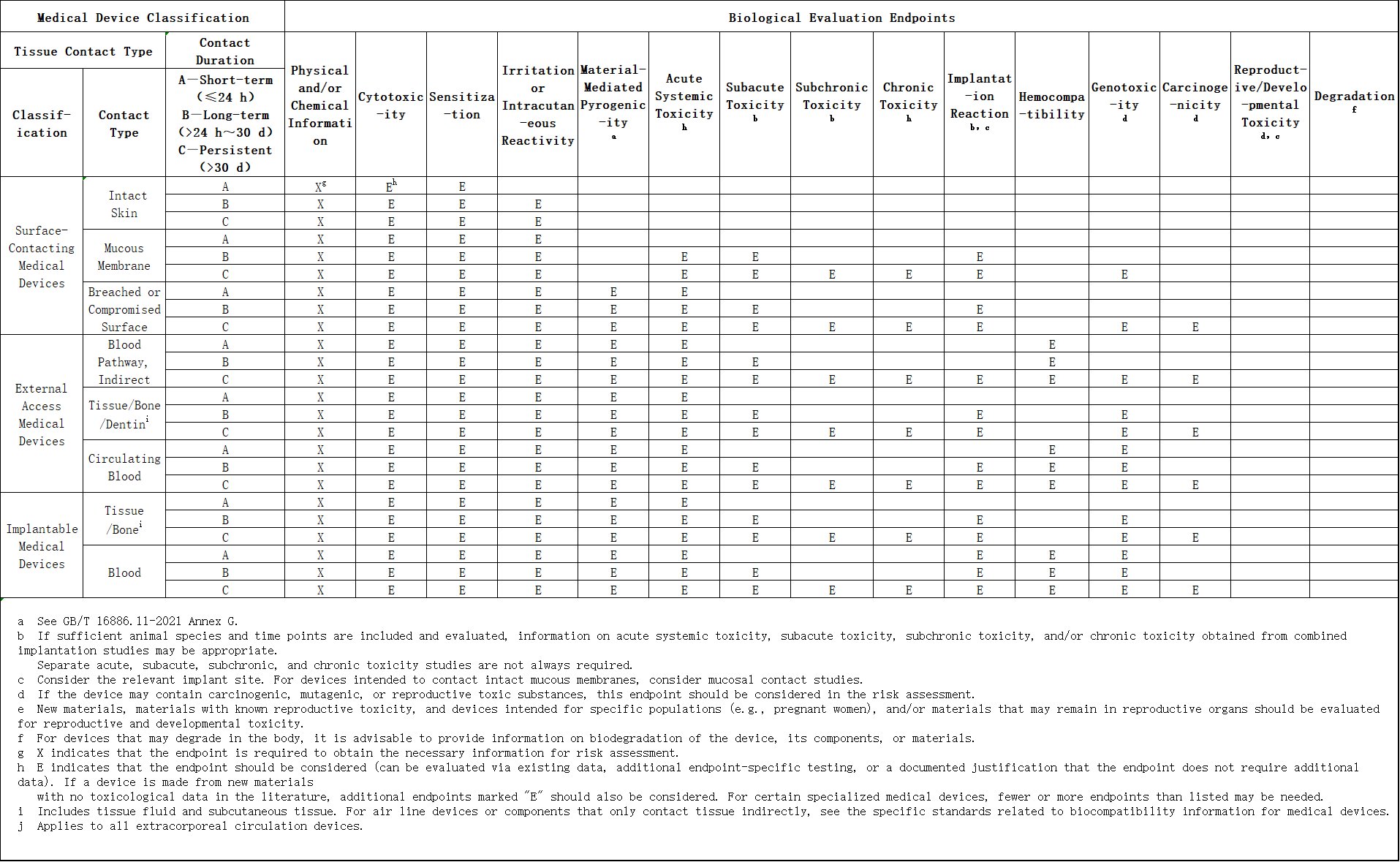
The biocompatibility of medical devices is a comprehensive evaluation process. It first involves precise risk classification of the device based on the contact site and duration of exposure. Subsequently, in accordance with ISO 10993-1 and the GB/T 16886 series standards, a corresponding set of risk-oriented biological evaluation items and testing strategies is established to ultimately ensure the safety of the device when used on humans.