

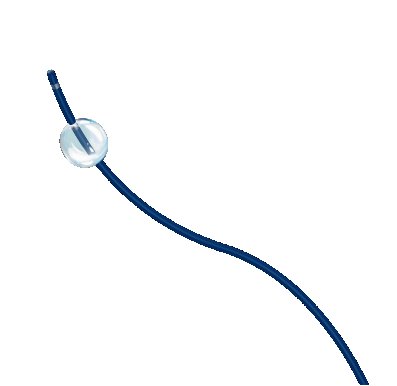
The balloon occlusion microcatheter is an interventional medical device that integrates balloon occlusion functionality with microcatheter delivery capabilities. Like a standard microcatheter, it can be guided along a guidewire to reach deep within tortuous and narrow target vessels. It can also temporarily occlude local blood flow by inflating the distal balloon, enabling the precise delivery of drugs or embolization agents in a "disturbance-free" environment while effectively preventing backflow of therapeutic agents that could damage normal tissue .This design eliminates the need for physicians to change instruments during the procedure, enabling an integrated "delivery + occlusion" workflow .
Its operating principle is based on two core mechanisms: First, physical occlusion, where the compliant balloon conforms to the vessel wall upon inflation, forming a mechanical barrier that blocks forward blood flow while preventing the backflow of embolization agents or drugs;Second, the pressure gradient effect: after the balloon occlusion, proximal blood flow ceases, but distal microcirculation continues. When the therapeutic agent is injected through the microcatheter at this point, a pressure difference is created between the occlusion site and the distal end, actively "drawing" or "driving" the therapeutic agent into the microvascular network of the lesion, thereby enhancing penetration and therapeutic efficacy .
The components of a balloon occlusion microcatheter primarily include the following parts :
lCatheter Body: A double-layer structure, with an inner layer of polytetrafluoroethylene (PTFE) for low friction and ease of delivery, and a tungsten wire braid around the body to enhance support and pushability, providing a stable delivery pathway.
lBalloon: Located at the distal end of the catheter, it is made of highly elastic medical-grade polymer materials and conforms to the vessel’s shape when inflated , with a maximum diameter of 6 mm.
lTip: Soft-tip design to prevent vascular damage; two platinum-iridium radiopaque markers (dual radiopaque rings) at the distal end facilitate precise positioning under fluoroscopy.
lHub/Connector: Luer-lock connector with three ports, used for balloon inflation and drug/embolization agent delivery, respectively.
lSurface coating: The distal surface is coated with a hydrophilic coating; once wetted, it improves the catheter’s lubricity and reduces friction with the vessel wall.
Balloon occlusion microcatheters are primarily used in the following scenarios :
lOncology Interventions — Liver Cancer Treatment: Used for balloon-occluded transarterial chemoembolization (B-TACE) and balloon-occluded hepatic artery infusion chemotherapy (B-HAIC).After occluding the tumor-feeding arteries with the balloon, injecting embolization agents or chemotherapeutic drugs prevents ectopic embolization caused by reflux. Simultaneously, the pressure gradient effect drives the drugs deeper into the tumor, thereby increasing tumor necrosis rates and complete response rates. Interventional therapy is widely recognized as the treatment of choice for intermediate- and late-stage liver cancer.
lNeurointerventional Procedures: Used for embolization of cerebral arteriovenous fistulas and arteriovenous malformations, as well as for temporary vessel occlusion during mechanical thrombectomy for acute ischemic stroke to reduce emboli escape.
lOther Applications: Marshall ethanol ablation and occlusion, temporary occlusion of small vessels, etc.
| Characteristics | Detailed Description |
| Balloon Type | Conformable Balloon—Expands to conform to the vessel’s shape upon inflation, adhering to the vessel wall to effectively occlude blood flow while preventing damage to the vessel wall. |
| Typical Materials | Eedical-grade polymer materials, including thermoplastic polyurethane (TPU), silicone, and thermoplastic elastomers (TPE). |
| Compliant Advantages | Can expand to match the size of the target vessel, with a maximum diameter of 6 mm, making it suitable for vessels of various diameters. |
| Radiopacity | Balloon catheters typically contain radiopaque additives (such as barium sulfate or tungsten) to ensure visibility under X-ray. |
| Comparison Criteria | Balloon Occlusion Microcatheter | Standard Microcatheter |
| Anti-reflux Capability | Strong. The balloon physically seals the microcatheter, creating a mechanical barrier that fundamentally prevents backflow of the embolization agent. | Weak. Relies on the operator’s experience to control injection pressure, making reflux and subsequent ectopic embolization likely. |
| Injection Efficiency | High. Animal studies show increased microsphere delivery volume and reduced injection time. | Low. Requires slow, low-pressure injection, which is time-consuming. |
| Embolization Effectiveness | Excellent. Superior results in embolization volume, postoperative tumor response rate, and postoperative survival rate. | Average. Due to limitations related to reflux and perfusion, there is a higher risk of incomplete embolization. |
| Ease of Use | High. The "delivery + occlusion" system is integrated, eliminating the need for intraoperative instrument changes. | Low. If occlusion is required, an additional balloon catheter must be used, increasing the number of procedural steps. |
| Risk of Vascular Injury | Low. The compliant balloon and soft-tip design provide maximum protection for the vessel wall. | Moderate. However, the lack of reflux control may lead to serious complications such as ectopic embolism. |
| Passability | Outer diameter of 2.7F (1.8F for some products); slightly less effective than ultra-thin catheters in extremely tortuous vessels. | Thinner outer diameter (up to 1.5F–2.0F), offering superior deliverability. |
| Operational Difficulty | Higher. Requires precise placement and accurate control of balloon inflation. | Lower. Traditional selection techniques are more familiar to operators. |
Advantages
| No. | Description of Advantage |
| 1 | Integrated "Delivery + Occlusion": A single catheter performs the three steps of superselective access, occlusion, and injection, eliminating the need for intraoperative device changes and simplifying the procedure. |
| 2 | Physical anti-reflux: The balloon creates a mechanical barrier, eliminating ectopic embolism at its source and significantly enhancing safety. |
| 3 | Pressure Gradient Effect: After balloon occlusion, the pressure differential actively drives the therapeutic agent into the microvasculature of the lesion, improving penetration. |
| 4 | Vascular-friendly: A compliant balloon combined with a soft tip design ensures effective occlusion while maximizing protection of the vascular wall. |
| 5 | Precise positioning: Dual radiopaque ring design facilitates clear visualization and positioning under intraoperative fluoroscopy. |
| 6 | Excellent Compatibility: A larger inner lumen (e.g., 0.020 inches) facilitates the delivery of other instruments or embolization materials. |
Disadvantages
Summary: Through two core mechanisms—"physical anti-reflux" and the "pressure gradient effect"—balloon occlusion microcatheters demonstrate significantly superior safety and efficacy compared to standard microcatheters in the fields of oncolology and neurointerventional procedures.Currently, domestically produced products (such as OccluFar®) have filled a gap in the domestic market, and with the emergence of innovative technologies such as 1.8F ultra-thin models and side-lumen designs, their application scenarios are continuously expanding. Xingchuang currently offers highly conformable balloons made of TPU, TPE, and silicone materials suitable for balloon occlusion microcatheters. We can select materials and customize specifications according to customer needs. We welcome inquiries from all customers.